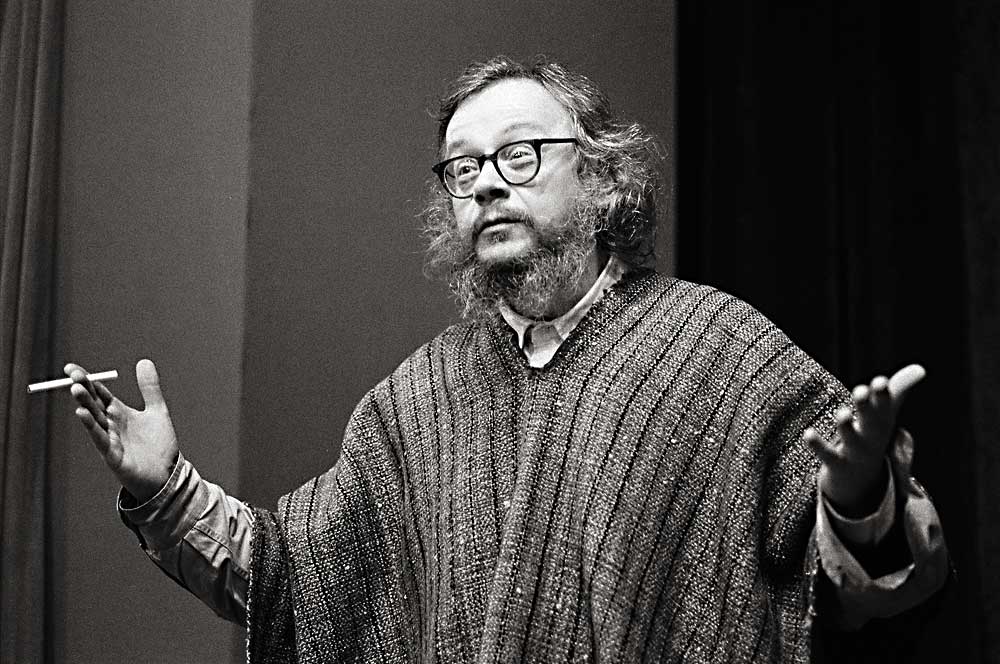
Jerzy Grotowski August 11, 1933 - January 14, 1999
If you want to create a masterpiece you must always avoid beautiful lies.
Grotowski was a Director of Theatre and theoretician, educator, creator of acting methods. Born in 1933 in the city of Rzeszów in southeastern Poland and died in 1999 in Pontedera, Italy. He is considered to have been one of the greatest reformers of 20th century theatre. In 1955 Grotowski graduated from the State Higher School of Theatre in Kraków with a degree in acting. He went on to study directing at the Lunacharsky Institute of Theatre Arts in Moscow in 1955-1956.
He believed in the actor himself and not the spectacles surrounding it. His belief was that in order to create great theatre, the main concern should be the work of the actor with the audience and not the lighting, sound, costume etc. These he said were just unnecessary 'trappings'. This is why he called it poor theatre because he 'stripped' away the superfluous aspects to theatre leaving just the actor vulnerable. He wanted actors to have full control over their bodies and wanted their movement and physicality to be raw. What a Holy Actor needs to “sacrifice” are his psychophysical blocks to playing a role. This idea that the actor should strip himself of skills and effects instead of accumulating them is called “via negativa”. Via Negativa, though, may very well involve mastering “techniques”, whether they are mental or physical. Precision and quality are vital for this goal, making training and exercises especially important for Grotowskian theatre. Grotowsky focus on that of an actor audience relationship which he says is the most sacred thing on stage and shouldn’t be overshadowed by the “riches” of decorative staging. As he saw the sole focus on the actor rather than the rest of the set as something necessary to create great Theatre. According to Grotowsky, the skills of the actors would be overshadowed and become of less importance in modern works. He saw all these big theatrical devices as a nuisance and chose not to work with them for the sake of not stealing the limelight of the actor themselves. Poor theatre was very powerful as it gave a chance for the actor to emit their emotions on a somewhat blank canvas, to then show to the audience without having to be assisted by light, sound, costume etc. He didn't use anything extra to show the true potential of an actor and therefore make them the only thing on stage that could acquire any attention whatsoever. From this the actors could not afford to be anything less than fully committed on stage and could not rely on sound, light etc. to carry them through the rest of the scene via audience attention. This was an exhaustive process, but it turned out to create powerful theatre and held great significance in the art world. Of course Grotowsky’s devising process is solely character development and doesn’t involve external “inspirations” as they all come from within the actor. Frantic use contemporary music as stimuli and play as an ensemble to create material.
Grotowski believed the perfect actor “sacrifices” his body to acting, hence the term “holy actor”. The opposite is a courtesan actor “sells” his body for money and fame. Only the Holy Actor is capable of performing the “Total Act”, or an act that doesn’t veer from the purpose of theatre. He always made his cast run for hours through the forest, sometimes naked. This was used to embrace everything around them to build themselves as a human. Not only that, but to also keep themselves in touch with their emotional side. He believed that exhaustion is key to tuning into ones emotions and exhaustion before going on stage could improve the performance. So when the actor is able to call upon the needed emotions with ease in a scene and therefore create a much more genuine character as those emotions are true to the actor. So the exhaustion exercise was essentially for character development. Grotowsky would also make them rehearse in all black with plain black rehearsal space and blocks. He would make his actors go through demanding exercises as it was important to Grotowski that actors could use their bodies. Grotowski was inspired by Artaud’s work and ideas. He was influence by Artaud's idea of total theatre. As well as the aforementioned exhaustion of actors to heighten natural emotions, he seeks for means of getting his theatre to come from raw sources. Overall both their works are fantastic in very different ways; they are creative, unique and experimental for their time. Grotowski's work is so powerful to an audience because all the emotions and movements are raw and real as he focuses on the heart of the actor
Exploring Grotowski's ensemble work enabled us to "play" and opens barriers of imagination. It frees up the mind from the outside world. As actors we need to be able to play and not take ourselves too seriously. We began with the exhaustion exercise. We did this exercise in an immaculate room in science. Analyzing this after the lesson in discussion we found that the purpose was to clear the space to allow our minds to be clear and to do the exercise like a meditation, forming a clean canvas within us.We ran around the room like Grotowski made his actors except the spiritual experience of being naked in a forest which we just left to the imagination. We needed to inspire ourselves as hard as we could to go ahead to the point where we killed every one of our contemplations and mechanically submerged ourselves in the act, moving around the room in different directions.
At that point the gathering run went outside, where we carried on until we were depleted. This physically exhausting and additionally objectively draining as you basically expected to see through the fatigue.Upstairs we started to do an activity where the ensemble ran round in circles in sync with the same beat as each other. We proceeded with this, going around the room now not in the circle. We were told to register each other as we moved around the room sharing snippets of synchronicity proceeding with the same beat.
Grotowsky in our pieces
Traditional theatre spaces were ignored by Grotowski in preference for rooms and buildings
and he saw little need for a traditional staging to eliminate the division between actor and audience, creating a communion between the two. Throughout our piece there's an exploration of the communication between participant and spectator or the actor-audience relationship. We're trying to show the audience what mental health looks like and at the start of the piece we physically take them by their hands and bring them to face the space. This can be effective for the audience as they know they're entering a different dimension of theatre. But can have implications if the actors are not immersed enough in the piece.
By devising our pieces through Poor Theatre, we intend to use poor props for our reparative soundscape. We went around Selhurst finding miscellaneous objects too many props strays from grotowski's methods as a director/practician and I'll be wearing all black because it's simple and there's nothing to be read from it and also I'm a theatre student in the actual piece and we wear all black anyway
